
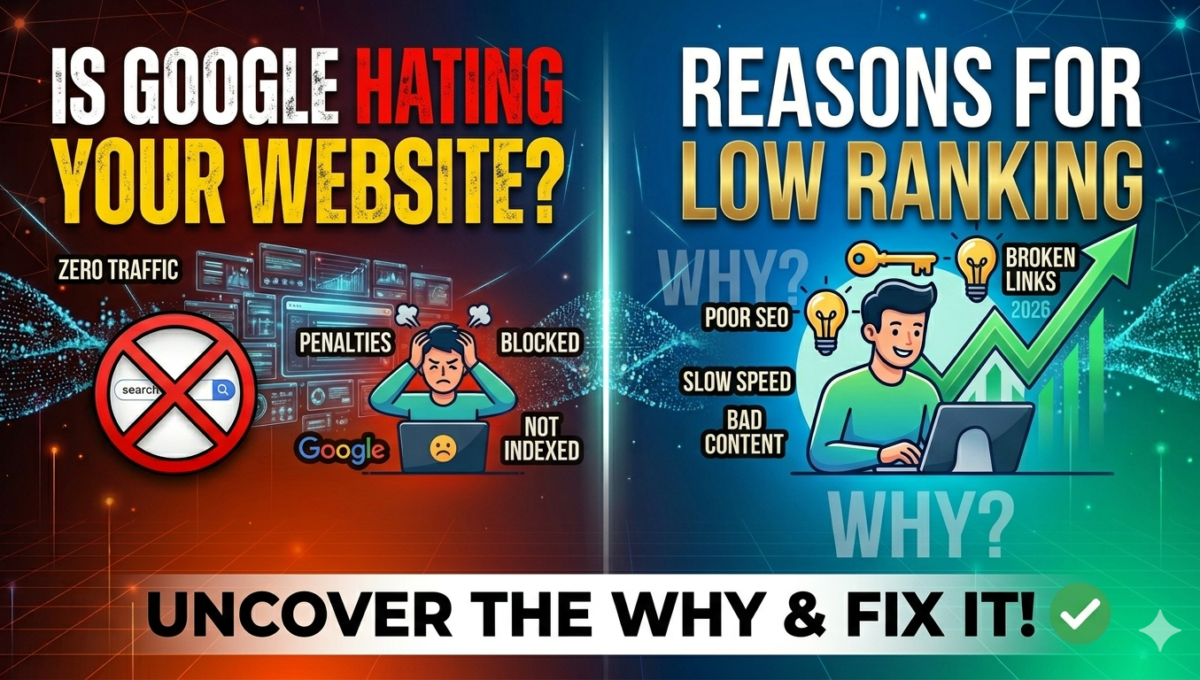
Why Your Website Is Not Ranking on Google
If your website pages are not appearing in high rankings on Google, it does not mean that Google dislikes you or your website. It simply means that your content quality is not strong enough yet to rank.
There can be many reasons why your blog is not appearing in top rankings, and today we will discuss those reasons and how to fix them.
I have categorized these issues into three main parts:
- Technical issues
- Content issues
- Link issues
Technical Issues
Sometimes, when we install a plugin, there is a toggle option called “No Index.” If this is enabled, it tells Google not to index any pages of your website.
If your pages are not indexed, Google cannot crawl them, and if Google cannot crawl your pages, it cannot rank them.
So make sure to check:
- Whether “No Index” is turned on
- Your robots.txt file
You can use online tools to check and validate your robots.txt file.
Manual Penalty
Another issue can be a manual penalty. If your website has received any manual action from search engines, there is a chance that Google has put your site in a kind of sandbox.
Because of this:
- Google may stop crawling your website properly
- Your pages may not rank
This usually happens if you have used spammy content or spammy link building.
Recovering from this can take 9–10 months or more.
Time Factor
There is no guarantee of how quickly a page will rank.
If your website has:
- Good authority
- Strong link building
- Proper optimization
Then rankings can come faster.
But research shows:
- Around 22% of keywords rank within 1 year
- Around 30% rank in the second year
- The remaining 60–70% can take up to 3 years to reach the first page
So if your keyword has been live for 2–4 months, wait a bit. If it still doesn’t rank, then start improving it.
Content Issues
Content quality is very important, but “quality” is subjective. So let’s break it down simply.
Does Your Content Fully Answer the Query?
Ask yourself:
Does your article completely satisfy the search query?
For example, if the topic is “turmeric on my skin,” many websites will have written about it.
Google will rank the article that gives the best and most complete answer.
So make sure:
- Your content explains the topic thoroughly
- It directly solves the user’s query
Thorough does not mean increasing word count. It means explaining clearly and completely.
Avoid Plagiarism and AI-Only Content
Do not publish:
- Rewritten content
- Fully AI-generated content without value
Instead, focus on writing genuine content.
Importance of Updating Content
If you have already published many articles but never update them, your rankings will drop.
Example:
If you wrote “Best Headphones in 2022” and now it’s 2023, users will prefer updated content.
Google also prefers fresh and updated articles.
So always update content when needed.
Updating sends a positive signal to Google that:
- You maintain your content
- You care about user queries
Detailed Content
Detailed content does not mean long content.
It means:
- Writing only what is necessary
- Covering the topic deeply
If a topic can be explained in 1000 words, write 1000 words. Do not stretch it to 3000 unnecessarily.
Solutions for Content Issues
- Create an outline before writing
- Cover all important points
- Write original, plagiarism-free content
- Add experience and expertise
For example:
If you are writing about turmeric for skin, you can add:
- Personal experience
- Practical methods
- Real-life tips (like traditional remedies)
- Images showing usage
This builds trust and shows expertise.
Link Issues (Link Building)
Link-related issues are slightly technical and depend on different metrics.
These can be divided into three parts:
- Page-level authority
- Topic authority
- Website authority
Page-Level Authority
Before writing an article, check:
- Which pages are ranking
- How many referring domains they have
- The quality of those backlinks
If a page has 500 high-quality backlinks, it will be hard to outrank.
But if competitors have fewer backlinks, you have a chance.
Topic Authority
When you search a keyword, check:
- Which websites are ranking
- Whether they are niche-specific or general websites
Niche websites are harder to beat because they already have strong topical authority.
If general websites are ranking and you are a niche site, you have a better chance to rank.
Website Authority
Website authority is not an official Google metric but is used by SEO tools.
It is based on backlinks:
- Strong backlinks = high authority
- Weak backlinks = low authority
Before targeting a keyword, check:
- Competitor domain authority
- Your domain authority
If your authority is much lower, it will be difficult to outrank them.
The Real Link Problem
Sometimes:
- Your content is perfect
- No technical issues exist
But still, you don’t rank because of weak backlinks.
Link building is a complex process, and many people avoid it due to lack of budget.
Solution
- Choose a niche where heavy link building is not required
- Target low-competition keywords
- Focus on smart keyword research
In rare cases, people may directly visit your website, but this usually happens only when your site becomes well-known.
Final Thoughts
These are the main reasons why your website may not be ranking on Google. If you are facing any other issue, you can share it, and I will try to respond. If you want to learn more about SEO, blogging, and digital marketing, and if you found this useful, make sure to subscribe to the channel.